Published 10 September 2026
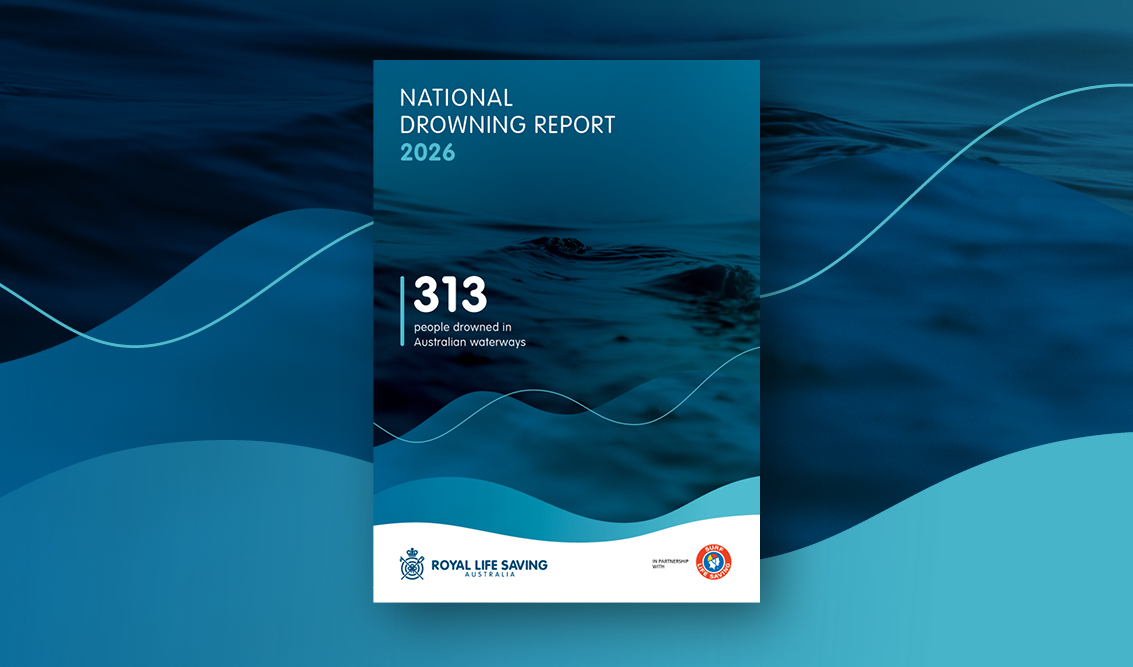
Australia recorded 313 drowning deaths in 2025/26. While this is an improvement on the record 357 deaths reported in 2024/25, the toll remains unacceptably high, still 10% above the 10-year average.
The National Drowning Report 2026, published by Royal Life Saving Australia in partnership with Surf Life Saving Australia, shows the nation is not on track to meet the 50% drowning reduction target set by the Australian Water Safety Strategy 2030.
Children aged 5-14 years had the lowest drowning rates, but drowning rates rises rapidly among adolescents and young adults. Thirty-four people aged 15-24 years drowned, 3% above the 10-year average.
Older Australians accounted for almost one third (30%) of all drowning deaths, with 95 people aged 65 years and older drowning in 2025/26. Drowning rates were above the 10-year average for every age group over 45 years, with those aged 65-74 recording the highest rate of any cohort.
Almost half of all drowning deaths occurred in coastal locations - beaches, ocean and rocks - accounting for 151 deaths (48%), including 66 deaths at beaches. One in three drowning deaths were in inland waterways (90 deaths or 29% of the total), including 68 deaths in rivers and creeks, where currents, submerged hazards and steep drop-offs often surprise swimmers.
Significant inequalities persist. Drowning rates were twice as high among people living in the most disadvantaged areas, and almost three times higher in regional areas compared to cities. Where country of birth was known, 39% of people who drowned were born overseas.
Royal Life Saving Australia and Surf Life Saving Australia say the report points to three deeper shifts already reshaping drowning risk in Australia, trends that will accelerate over the next decade unless addressed now. They cite declining swimming and water safety skills, an ageing population, and the effects of a changing climate as factors driving increases in drowning.
Royal Life Saving Australia Chief Executive Officer Dr Justin Scarr said
"To reduce drowning among people over 65, we must raise awareness of how medications and medical conditions affect water safety and promote the health benefits of swimming and gentle exercise in warm water at local pools.
"This report shows Australia is not on track to meet the Australian Water Safety Strategy 2030 goals. Reversing that trajectory demands continued commitment and enhanced investment from every level of government, alongside the efforts of communities and the water safety sector." Dr Scarr said.
Surf Life Saving Australia Chief Executive Officer Adam Weir said
“Coastal drowning remains a significant concern, with coastal locations including beaches, oceans, harbours and rocks accounting for half (48%) of the national drowning burden. This report shows there is more work to be done, including sustained investment in measures that reduce drowning risk at black spots and unpatrolled coastal locations.
“Beaches alone account for 21% of all drowning deaths and ocean/harbour locations saw a 55% increase on the 10-year average. Australia’s coastline is central to our way of life, but conditions can change quickly. Our advice remains the same: where possible swim at a patrolled beach, between the red and yellow safety flags and avoid taking unnecessary risks when enjoying our coastal environments." Mr Weir said.
The Hon Anika Wells MP, Minister for Communications, Minister for Sport said
"One life lost to drowning is one too many and this report shows there is more work to do for everyone.
“It is so important that every Australian has the knowledge and skills to ensure they can stay safe when having fun on and around the water.
"The Albanese Labor Government is continuing to invest in programs that boost Australians' awareness and ability when it comes to water safety, including the $5 million WE SWIM Multicultural Community Water Safety Program and funding for the Water and Snow Safety Program.
"We have some of the most beautiful beaches and waterways in the world. With summer approaching, many of us are getting back in the water, so I urge everyone to be aware of hazards, to learn to swim and to follow pool and beach safety rules to keep themselves and others safe."
The Report was released today at Parliament House, Canberra by The Hon Matt Thistlethwaite MP, Assistant Minister for Immigration and Assistant Minister for Foreign Affairs and Trade, who said
“The findings in this report are a reminder that drowning remains a major challenge across our coastline, rivers and communities.
“Too many families are losing loved ones in preventable incidents, and we must continue strengthening water safety skills and awareness nationwide.
“The Albanese Labor Government is supporting programs that build capability in every community, from multicultural water safety initiatives to local partnerships.”
The Australian Water Safety Strategy 2030: three national imperatives
A Midpoint Update Australian Water Safety Strategy 2030, published in January 2026, identified three National Imperatives, the priority areas where collective effort must be strengthened to change the drowning trajectory:
- Strengthening swimming and water safety skills for all, so every Australian has the skills to navigate currents, deep water, and unfamiliar aquatic environments safely.
- Localising water safety efforts, recognising that all drowning is fundamentally local, and that reducing it nationally means building local water safety coalitions and plans.
- Aligning policies and partnerships, connecting action from Canberra to states, territories and local government, all the way to the community pool, beach or riverbank.
The renewal of the Federal Government’s Water and Snow Safety Program, together with WE SWIM Multicultural Community Water Safety Program, provides a critical foundation for this work. Achieving the ambitions of the Australian Water Safety Strategy 2030 will take continued commitment and enhanced investment from every level of government, alongside the efforts of communities and the water safety sector.
Stay safe around water
Royal Life Saving Australia and Surf Life Saving Australia urge everyone to:
- Always supervise children in, on and around water
- Learn swimming, water safety and lifesaving skills
- Wear a lifejacket when boating, rock fishing or paddling
- Swim at a patrolled beach between the red and yellow flags
- Avoid alcohol and drugs around water
- Check weather, water and local conditions before entering the water
- Know your own swimming ability and avoid taking unnecessary risks
VIEW THE NATIONAL DROWNING REPORT 2026 HERE
----------------------------------------------------------------------------------------------------------------------------------------------------------------------------------------
B-Roll and images – htps://bit.ly/45whvi7
Media Contact: Ross Woodward, Media Key, 0409 420 112 or 03 9769 6488.
*all rates are crude rates. National Drowning Report State and Territory Findings follow.
NATIONAL DROWNING REPORT STATE AND TERRITORY FINDINGS
- 313 drowning deaths over the past 12 months, a 10% increase on the 10-year average.
- The lowest rates of drowning were children 5-14 years, but this rises sharply by ages 15-24 years.
- Drowning rates were above the 10-year average for every age group over 45 years.
- The highest drowning rates were in people aged 65-74-year age group.
- 48% occurred in coastal locations (151), including 66 drowning deaths (21%) at beaches.
- 29% at inland waterway locations (90), including 68 drowning deaths (22%) at rivers.
- 14% occurred in swimming pools (44 deaths), 66% of those deaths were in backyard pools.
- Where country of birth was known, 39% were born overseas.
- Inequities persist – drowning rates double for those from the most disadvantages areas and nearly triple for regional residents and nearly quadruples for remote residents compared to major cities.
- Drowning increased in South Australia (up 29%), Tasmania (up 25%), Queensland (up 19%), New South Wales (up 9%), and Victoria (up 8%) compared to the 10-year average.
Australian Capital Territory
Fewer than 5 drowning deaths occurred in the ACT.
New South Wales
109 drowning deaths occurred in New South Wales, a 9% increase on the 10-year average, a rate of 1.27 per 100,000 population. The highest number of drowning deaths were in the 45-54 year age group (19%). The leading locations for drowning were beaches (25%) and rivers/creeks (19%). The Mid North Coast and Far West regions had the highest rates of drowning per 100,000 residents.
Northern Territory
7 drowning deaths occurred in the Northern Territory, no change from the 10-year average, a rate of 2.63 per 100,000 population. The highest number of drowning deaths occurred among those aged 35-44 years (29%). Big Rivers and Top End regions had the highest rates of drowning per 100,000 residents. 57% of drowning deaths occurred at a river/creek, and 57% occurred during the wet season (November-April).
Queensland
80 drowning deaths occurred in Queensland, a 19% increase on the 10-year average, a rate of 1.41 per 100,000 population. 30% were among people aged 65-74 years. The leading locations for drowning were rivers (26%), beaches (25%), and swimming pools (20%). Swimming (38%) was the leading activity, followed by unintentional fall into water (17%). The Torres and Cape and North West Queensland regions reported the highest rates of drowning per 100,000 residents.
South Australia
18 drowning deaths occurred in South Australia, a 29% increase on the 10-year average, a rate of 0.95 per 100,000 population. 39% were people aged 65-74 years, the highest rate of any cohort at 3.44 deaths per 100,000 population. The leading locations for drowning were ocean/harbour (44%) and river/creek (22%). Boating (33%) was the leading activity, followed by unintentional fall into water (17%).
Tasmania
10 drowning deaths occurred in Tasmania, a 25% increase on the 10-year average, a rate of 1.73 per 100,000 population. 30% were people aged 75 years and over. The South East region had the highest rates of drowning per 100,000 residents. The leading locations for drowning were ocean/harbour (50%), beaches (20%) and rivers (20%). Swimming was the leading activity (30%), followed by boating (20%).
Victoria
53 drowning deaths occurred in Victoria, an 8% increase on the 10-year average, a rate of 0.75 per 100,000 population. 21% occurred in the 75+ year age group, the highest rate of any cohort at 1.95 deaths per 100,000 population. 38% occurred during the summer months. The leading locations for drowning were ocean/harbour (28%), rivers (23%) and swimming pools (21%).
Western Australia
35 drowning deaths occurred in Western Australia, a 5% decrease on the 10-year average, a rate of 1.15 per 100,000 population. The leading locations for drowning were beaches (34%), ocean/harbours (14%), rivers (11%) and swimming pools (11%). 29% occurred among people aged 45-54 years. 57% occurred during summer months, with December representing 31% of drowning cases. 37% of all drowning deaths in WA were people who resided in the most socioeconomically disadvantaged areas.