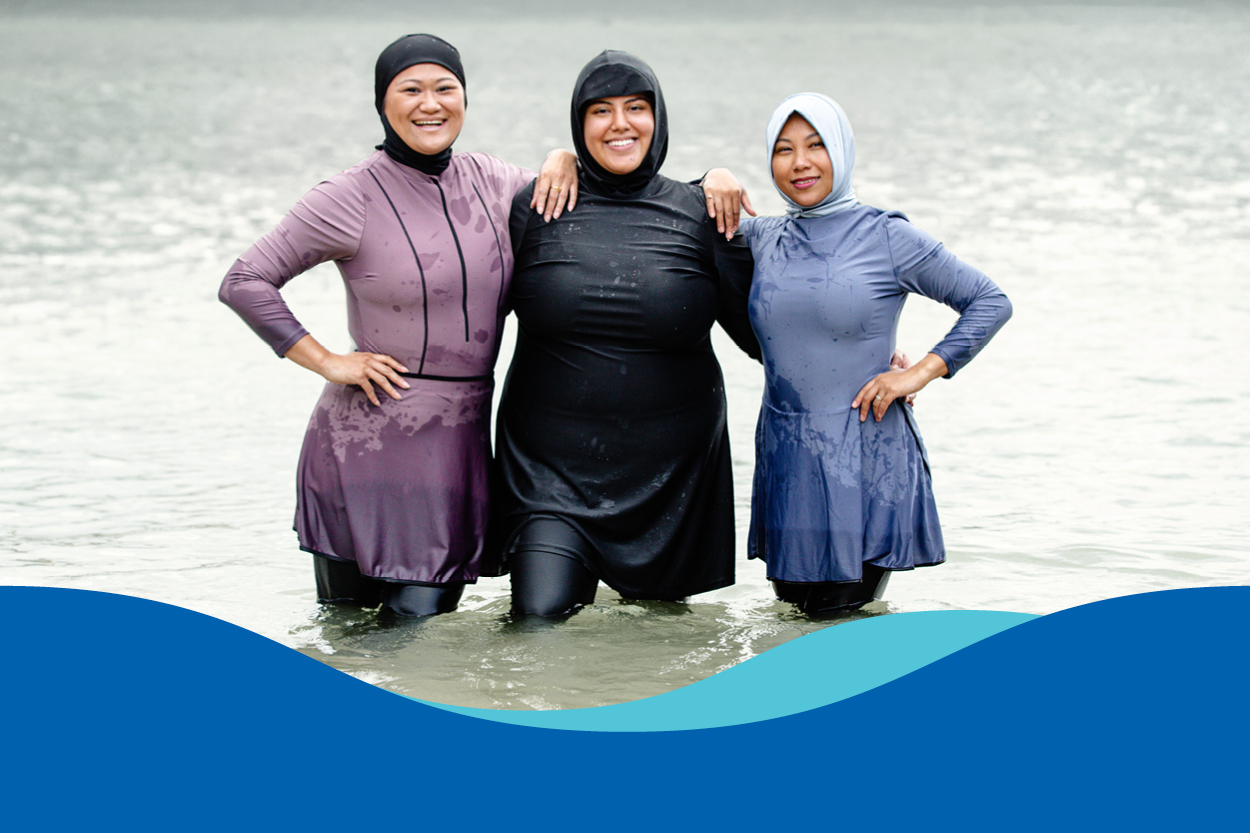
Place-Based Partnerships
This stream shift systems at scale - coordinating delivery across a diverse LGA or multi-LGA or regional corridors and hubs with concentrated overseas-born populations and elevated drowning risk.
Partnerships will generate co-investment and build local capability that outlasts the funding period.
Update: 25/09/2026: GRANT ROUND NOW CLOSED
WHAT'S ON OFFER
Grant range: up to $100,000 (excl. GST) per partnership
Funds available: approximately $1,500,000 (excl. GST)
Application type: open grant
WHO SHOULD APPLY
A lead organisation applying on behalf of a consortium that includes:
- At least two multicultural, settlement or community partner organisations
- At least one council or council representative
- At least one water safety organisation and/or aquatic provider - a pool, aquatic facility, swim school or similar
The lead applicant must be an incorporated not-for-profit or incorporated body with the governance and financial capability to manage a partnership at this scale.
THE FOUR WE SWIM PILLARS
Every funded activity activates one or more of:
- WE CONNECT - build links between multicultural communities and local aquatic facilities, swim schools, clubs and councils
- WE WELCOME - improve cultural safety, create welcoming aquatic environments, expand workforce and leadership pathways
- WE PROMOTE - deliver targeted, multilingual water safety messages through trusted voices
- WE LEARN - remove barriers to swimming and water safety education, and build skills to agreed benchmarks
HOW FUNDING IS USED
- A strong in-water component required within the delivery allocation
- Co-investment expected - matched or higher cash and in-kind contributions from consortium partners
- No more than 20% to coordination
GOVERNANCE AND SUPPORT
- Each partnership establishes a Local Community Coalition (Steering Group), meeting at least monthly, to guide co-design, monitor delivery and plan for sustainability
- Full participation in Royal Life Saving’s monitoring, evaluation and learning (MEL) framework is a condition of funding
GET IN TOUCH
Talk to us before you apply. Early conversations help test program fit, confirm geography, and clarify co-design and co-investment expectations.
GUIDANCE

SUPPORT RESOURCES


Frequently Asked Questions
WE SWIM General
About the WE SWIM program
1. What is WE SWIM?
WE SWIM: Multicultural Community Water Safety Program is a national, evidence-informed initiative to reduce drowning risk, remove barriers to swimming and water safety education, and build belonging for refugees, recently arrived migrants and broader multicultural communities.
2. Who funds and who leads it?
WE SWIM is funded by the Australian Government and led by Royal Life Saving Society – Australia. Royal Life Saving Australia brings national coordination, facilitation of WE SWIM community partnerships, and monitoring, evaluation and learning into one cohesive program.
3. What problem is WE SWIM trying to solve?
Multicultural communities face higher drowning risk from layered vulnerabilities including lower swimming and water safety skills, limited familiarity with local hazards, and financial, language, cultural and access barriers to participation. These vulnerabilities and barriers are most pronounced for refugees and recently arrived migrants during settlement and the decade after and can persist across generations if unaddressed. WE SWIM exists to close that gap.
4. What are the four WE SWIM pillars?
Every funded activity activates one or more of the WE SWIM pillars. They are WE CONNECT (linking multicultural communities to local aquatic facilities, swim schools and clubs); WE WELCOME (improving cultural safety and creating welcoming aquatic environments); WE PROMOTE (delivering multilingual water safety messages through trusted voices), and WE LEARN (removing barriers to participation and building swimming and water safety skills). Each stream's funding guidelines suggests fundable activities for each pillar.
5. Who is WE SWIM for?
Four beneficiary groups: refugees in humanitarian and settlement support programs; recently arrived migrants (in Australia less than 10 years); broader multicultural communities facing access and equity barriers around water; and, where appropriate, international students. Emphasis falls on school-aged children and young people, with a secondary focus on adults and caregivers, whose choices shape family participation and safety.
6. How does WE SWIM align with national policy?
WE SWIM aligns to the Australian Water Safety Strategy 2030 and its target to reduce drowning by 50 per cent by 2030, the Commonwealth's Multicultural Access and Equity Policy, and the Multicultural Framework Review: Towards Fairness. It also reflects Royal Life Saving's strategic framework for eliminating drowning, empowering communities, strengthening safety and succeeding together, and every funded activity is expected to embody that same approach.
The WE SWIM funding streams
7. What are the WE SWIM funding streams?
There are three streams.1/ Place-Based Partnerships funds larger, multi-partner coalitions shifting systems across a multi-LGA or regional footprint. 2/ Community Programs funds targeted, single-organisation-led delivery in one local government area. 3/ Pathfinders which include WE SWIM Pathfinder: Refugee Settlement which funds a small number of pilots integrating water safety into settlement pathways, and WE SWIM Pathfinder: Multicultural Community Ambassador Program funds trusted community voices to deliver communications and advocacy activity. Contact weswim@rlssa.org.au if you're unsure which stream fits your idea.
8. Can we apply to more than one WE SWIM stream at the same time?
Yes. Each stream's funding guidelines set out how many applications a lead organisation can submit within that stream. If you're considering more than one stream. For example, leading a Community Programs application while joining another organisation's Place-Based Partnership as a partner. Talk to us early to avoid overlapping or duplicate proposals.
9. What's the indicative timeline across the WE SWIM funding rounds?
Most streams follow a similar rhythm: documentation released from 18 August 2026, applications closing 24 September 2026, outcomes notified 16 October 2026, and agreements executed shortly after. Delivery generally runs 1 November 2026 to 31 May 2027, with final reporting due by 30 June 2027.
10. Is co-investment required across all streams?
Most streams expect cash and/or in-kind co-investment including things like venue access, staff time, translation or transport support. Clearly describe any co-investment in your budget. Requirements vary by stream and scale, so check your stream's funding guidelines.
Applying through our online grants platform
11. How do we submit an application?
Through the Royal Life Saving Grant Hub. Which is an externally supported online platform, not email or paper. You'll set up an account, complete your application online, upload supporting documents, and submit directly through the platform. We'll provide the link and access instructions when each round opens.
12. Can more than one person work on our application?
Yes. The platform's 'collaborate' feature lets multiple people from your organisation and partnership contribute to the same application – drafting sections or reviewing the budget together. However, the lead organisation must create and submit the application; partners using collaborate cannot submit on its behalf.
13. Who can help us if we have questions before or during our application?
Royal Life Saving's WE SWIM team at weswim@rlssa.org.au. Reach out before submitting – early conversations can confirm program fit, eligibility, partnership expectations and cultural safety considerations, and we can help with technical questions about the platform.
Templates and required documents
14. Can we use our own templates for the workplan, budget, risk assessment or letters of support?
No. Several streams require a workplan, budget, risk assessment and letters of support, and Royal Life Saving has created templates for all of these – find them in the resources section of our website. Please complete and submit using only our templates, not your own formats, so every application can be assessed consistently.
Designing inclusive, safe programs
15. What does Royal Life Saving mean by designing programs with intersectionality in mind?
Programs should be designed with intersectionality in mind, recognising that people often hold overlapping inclusion and access needs across factors including culture, disability, gender and neurodiversity. Programs should be genuinely strengths-based, non-tokenistic, and reflect the real, layered identities of the people they serve rather than treating each factor in isolation.
Reporting, evaluation and staying in touch
16. What is MEL, and what will we report on?
Monitoring, evaluation and learning (MEL) is the program's accountability framework; full participation is a funding condition, proportionate to your project's scale. Royal Life Saving provides common indicators, templates and guidance. Reporting generally covers activity delivery, participant data, access and inclusion outcomes, co-investment, risks and practical learning.
17. Who do we contact with general questions about WE SWIM?
For any general question, or if you're unsure which funding stream fits, contact weswim@rlssa.org.au. More information and our resource templates are at royallifesaving.com.au.
WE SWIM Place-Based Partnerships
Eligibility and who can apply
1. Who can apply for WE SWIM Place-Based Partnerships?
A lead organisation applies on behalf of a consortium – not alone. It must be incorporated and able to govern a partnership including at least one council, two multicultural or community partners, and one water safety or aquatic provider. Multiple people can contribute via the platform's 'collaborate' feature, but only the lead submits. See section 2.1 of the funding guidelines.
2. Can smaller, informal groups be partners?
Yes. Smaller, grassroots groups are welcomed – they bring essential community trust. They don't need to be the lead applicant; joining as a named community partner still shapes the partnership's design and delivery. See section 2.1 of the funding guidelines.
3. What's the minimum consortium composition?
At least one council, two multicultural or community partners serving priority communities, and one water safety or aquatic provider. Add schools, universities, employment providers or settlement services as relevant to your corridor. See section 2.1 of the funding guidelines.
4. How many applications can one organisation lead?
Up to two, provided each is a genuinely distinct consortium with its own region or community focus. Talk to us early if you're weighing up more than one idea.
5. We work in one community only – is this the right stream?
Probably not – WE SWIM Community Programs suits single-community or catchment-scale proposals better. Place-Based Partnerships is for larger, systems-level change across multiple LGAs. Talk to us first. See section 2.3 of the funding guidelines.
Partnership, co-design and governance
6. What counts as genuine co-design?
Multicultural communities shape your partnership's priorities, activities and governance from the start – not just review a finished plan. We'll give practical guidance and support you to strengthen this practice over time. See section 8.3 of the funding guidelines.
7. What is a Local Community Coalition, and when do we need one?
A Local Community Coalition that guides co-design and plans for sustainability, with councils, providers and community organisations meeting at least monthly. It must be in place before you sign a funding agreement. See section 5 of the funding guidelines.
8. Will Royal Life Saving help connect groups applying in the same region?
Yes. Where we're aware of multiple groups in the same area, we'll help connect them rather than leave you competing for the same partners. Reach out early for introductions before applications close. See section 10.1 of the funding guidelines.
9. Can universities, TAFEs or English-language services be partners?
Yes – particularly where they build workforce pathways into swim teaching, lifeguarding and aquatic leadership, or build swimming vocabulary into English-language teaching. Including them can strengthen your application against the partnership design and workforce criteria.
Who we're prioritising, and cultural safety
10. Who are the priority communities and age groups?
Refugees, recently arrived migrants and broader multicultural communities facing ongoing access and equity barriers, plus international students where relevant. Priority life stages are school-aged children and young people aged 13–24, with a secondary emphasis on adults and caregivers – parent education alongside children's lessons is encouraged. See section 2.2 of the funding guidelines.
11. Are all visa categories welcome, or only refugees?
All are welcome – refugees, recently arrived migrants, longer-settled communities and international students. The priority is need, not a visa checklist; talk to us if you're unsure whether your community fits. See section 2.2 of the funding guidelines.
12. What does Royal Life Saving mean by “culturally safe”?
One where multicultural participants and families feel safe, welcomed and respected in language, gender norms, dress and trust – not just physically safe. In practice: trauma-informed delivery, community-led design, gender-sensitive options such as women-only sessions, and bilingual or interpreter support. See section 6 of the funding guidelines.
13. Will our staff need cultural safety training?
Yes. Everyone delivering the program must complete approved cultural safety training before activities begin. Royal Life Saving can help you access suitable training. Don’t stress, building cultural safety is a journey, so entry level training counts as a step forward.
14. Does “WE SWIM” mean participants must already know how to swim?
No – WE SWIM is an aspiration, not an eligibility test. Removing that exact barrier is the point of the funding.
Funding, costs and budget
15. What can grant funding be used for?
Staffing and coordination tied to delivery, venue and lane hire, instructor, lifeguard, bilingual worker and interpreter costs, multilingual communications, and barrier-removal supports like transport and modest swimwear assistance. Training, accredited courses and MEL costs are also eligible, with coordination capped at 20% of the grant. See section 3.2 of the funding guidelines.
16. What won't be funded?
We won’t fund things like business-as-usual overheads, capital works or major equipment, pre-agreement costs, or anything unrelated to drowning reduction, water safety, access or inclusion. Unapproved cash incentives and duplicate funding are also out of scope. Ask us in writing if you are unsure. See section 3.3 of the funding guidelines.
17. Is co-investment required, and what counts?
Yes – matched or higher co-investment is expected across your consortium, cash or in-kind (free pool entries, lane space, staff time, transport, communications support). Quantify it in your budget against each contributing partner. See section 4 of the funding guidelines.
18. Is this a one-off grant, or will it continue beyond one year?
Current funding covers one year, with delivery expected between November 2026 and May 2027. Strong outcomes may open scope to extend, but only this first year is certain. See section 10.3 of the funding guidelines.
19. Will funding support training providers delivering instructor or pool lifeguard courses?
Yes. Training and accredited course costs sit within eligible workforce development, particularly where they build pathways for multicultural people into swim teaching or lifeguarding – including partnering directly with training providers. See section 3.2 of the funding guidelines.
Submission, timelines and how this stream fits together
20. What's the timeline for this grant round?
Documentation opens 18 August 2026, applications close 24 September 2026, and applicants are notified by 16 October 2026. Delivery runs 1 November 2026 to 31 May 2027, with acquittal due 30 June 2027. See section 10.3 of the funding guidelines.
21. How are applications assessed?
All applications are assessed against a five common and weighted assessment criteria as follows 1) Community need and local fit (20%), 2) Partnership strength, delivery capability and sustainability (30%), 3) Alignment to WE SWIM pillars and outcome pathways (20%), 4) Value for money and co-investment (20%), and Monitoring, Evaluation and Learning (MEL) readiness (10%). See sections 8 and 9 of the funding guidelines.
22. Is help available for first-time applicants?
We provide tools, templates and direct coaching. Limited grant-writing experience shouldn't stop you applying. See sections 8 and 9 of the funding guidelines.
Frequently Asked Questions Additions (as of 11 September 2026)
1. Is Place-Based Partnerships open to newly established not-for-profit organisations?
Yes, if you meet the eligibility criteria. This funding opportunity expects a strong theory of change and program logic, and a Local Community Coalition that meets at least monthly and is in place before a funding agreement is signed. Newly established organisations should be confident they can carry this governance role. See sections 2.1 and 5 of the Place-Based Partnerships Guidelines.
2. What if our Place-Based Partnerships application looks like a better fit for Community Programs?
If screening suggests that Community Programs is a better fit, Royal Life Saving will contact you and, with your permission, move your application across. Community Programs is generally suited to a single local government area or tightly focused catchment. Place-Based Partnerships is for systems-level work across multiple local government areas, with coalition governance and a program logic. See section 2.3 of the Place-Based Partnerships Guidelines and Community Programs Guidelines.
3. Could a partnership include the Adult Migrant English Program at our local TAFE and a council aquatic facility?
Yes. Universities, TAFEs and English-language services are welcome partners, particularly where they build water safety vocabulary into English-language teaching, connect learners and families to the local pool, or open workforce pathways. A council aquatic facility can also be a valuable aquatic delivery partner. See question 9 of the FAQ and section 2.1 of the Place-Based Partnerships Guidelines.
4. Can we partner with several councils to extend reach across multiple areas?
Yes. Place-Based Partnerships is designed for multi-LGA and regional-corridor work where you can form and manage a coalition. You can also join another organisation’s consortium. A lead organisation may submit up to two Place-Based Partnerships applications, provided each is a genuinely distinct consortium with its own region or community focus. See question 4 of the FAQ and sections 2.1 and 2.3 of the Place-Based Partnerships Guidelines.
5. Is a letter of support enough to formalise a partnership with an aquatic provider?
Yes. Name each partner and their lead contact in your work plan, then upload a signed letter of support from every partner using the Royal Life Saving template. A strong letter states who the partners are, what each will do and contribute, whether cash, lane space or administration time, and the timelines. Templates are available in the resources section above.
6. The application asks for referees on our track record. What if we do not have this?
A lead applicant should ideally demonstrate a track record either as a multicultural community organisation or of working with multicultural communities, and referees help verify this. If you are newly established, make a strong case for your capability. In some circumstances, partnering with an organisation that is already trusted by the community may be the stronger approach. If you need guidance about your circumstances, email weswim@rlssa.org.au.